
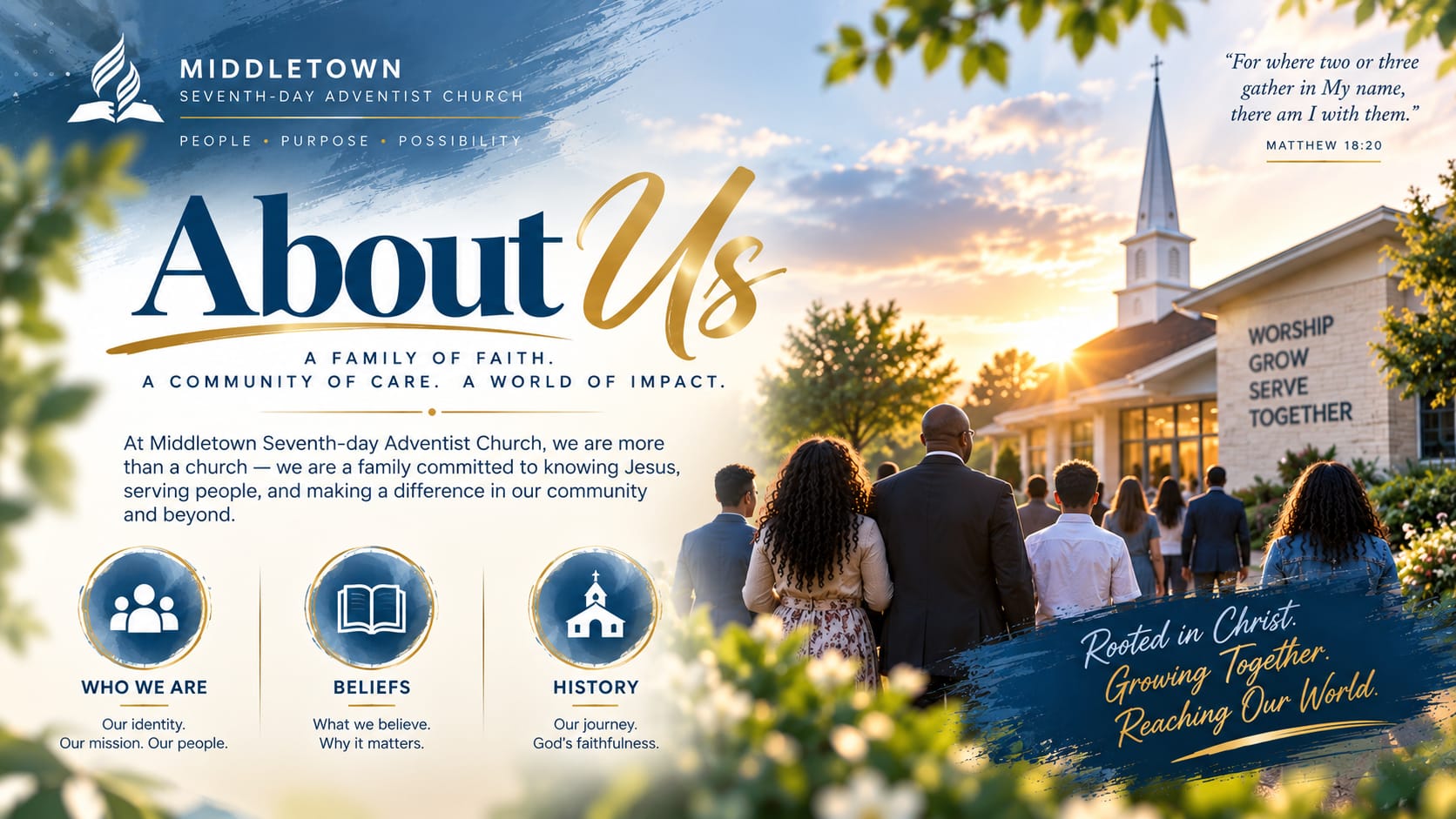
Learn More About Us Below

WHO WE ARE
North of NYC bustle and south of complete rural solitude, the Middletown Seventh-Day Adventist Church feels right at home in an upstate New York town of the same name. With a central location and hilltop foundation laid on none other than Jesus Christ, this uniquely shaped sanctuary invites old friends, new faces, passers through, and passers by to find warm welcomes, quiet rest, and a good Word. Join us for Sabbath (Saturday) worship or at any of the events listed on our calendar

What do Seventh-Day Adventists Believe?
Are you new to Adventism?
If so, we invite you to learn more about our beliefs and who we are as a Christ-centered church family. Click the link below to discover what we believe and how we seek to follow Jesus in faith and service.
The Seventh-Day Sabbath
We believe that the seventh day, Saturday, is sacred and that God intends for humanity to rest on this day just as He rested at creation. This principle was established in the Ten Commandments, where God clearly instructs, “Remember the sabbath day, to keep it holy”. (Exodus 20:8)
The Second Coming of Jesus
We believe in the Second Advent of Jesus as referenced in Matthew 24: 30, “and they shall see the son of man coming in the clouds of heaven with power and great glory.” This is our blessed hope, as Jesus will come and put an end to death and sin.
The State of the Dead
Seventh-day Adventists believe that there is no conscious existence after death, that death is a temporary sleep, and that the hope of the believer rests in the resurrection at Christ’s return, not in an immortal soul leaving the body at death (John 5:28–29).
The Sanctuary Message
The Seventh-day Adventist sanctuary message is a central teaching that explains Jesus Christ’s ministry in heaven and its significance for humanity. Adventists believe that the sanctuary described in the Old Testament was a model of Christ’s heavenly ministry, showing how God deals with sin


Our Pioneers
During the late 1840s and 1850s, leaders such as James White, Joseph Bates, and Ellen G. White played central roles in shaping and organizing the movement. Ellen G. White, who received prophetic visions, became especially influential through her writings on theology, Christian living, health, and education. In 1860, the group formally adopted the name “Seventh-day Adventist,” and in 1863 the General Conference of Seventh-day Adventists was officially organized, marking the church’s formal establishment. At that time, the denomination consisted of only a few thousand members, primarily in the United States.